

Efectos del manejo y el establecimiento de dos especies de plantas sobre la estructura de un suelo salino
Barra lateral del artículo
Contenido principal del artículo
Resumen
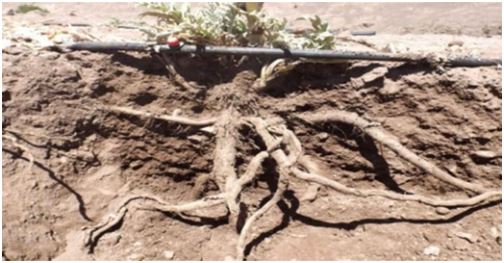
La investigación tuvo como objetivo evaluar el efecto del manejo y el establecimiento de dos especies de plantas sobre la estructura de un suelo salino. Se describió el estado de la estructura del suelo de dos áreas con plantaciones establecidas de alcachofa (Cynara scolymus L.) y alfalfa (Medicago sativa L.), utilizando la metodología del Perfil Cultural. El manejo del suelo en los cultivos incluyó la aplicación de abonos órgano-minerales y riego. Los resultados muestran que bajo las condiciones del cultivo de alcachofa el sistema radical se mostró vigoroso y entrelazado con el suelo, lo cual crea una condición muy favorable para la entrada y conservación del agua al mismo. La cobertura progresiva de la alfalfa permitió el establecimiento de una macrofauna y de microorganismos asociados de manera simbiótica (Rhizobium meliloti), formando nódulos en las raíces, lo cual produjo un desarrollo favorable de la alfalfa y una evidente regeneración de la estructura.
Downloads
Detalles del artículo

Esta obra está bajo una licencia internacional Creative Commons Atribución-NoComercial 4.0.
Aquellos autores/as que tengan publicaciones con esta revista, aceptan los términos siguientes de la Licencia CC Atribución/Reconocimiento-NoComercial-CompartirIgual 4.0 Internacional (CC BY-NC-SA 4.0):
Usted es libre de:
- Compartir — copiar y redistribuir el material en cualquier medio o formato
- Adaptar — remezclar, transformar y construir a partir del material
- La licenciante no puede revocar estas libertades en tanto usted siga los términos de la licencia
Bajo los siguientes términos:
- Atribución — Usted debe dar crédito de manera adecuada , brindar un enlace a la licencia, e indicar si se han realizado cambios . Puede hacerlo en cualquier forma razonable, pero no de forma tal que sugiera que usted o su uso tienen el apoyo de la licenciante.
- NoComercial — Usted no puede hacer uso del material con propósitos comerciales .
- CompartirIgual — Si remezcla, transforma o crea a partir del material, debe distribuir su contribución bajo la la misma licencia del original.
- No hay restricciones adicionales — No puede aplicar términos legales ni medidas tecnológicas que restrinjan legalmente a otras a hacer cualquier uso permitido por la licencia.
Cómo citar
Referencias
BALDRICH, A., VILLALÓN, F. y GILLET, G. 2000. Manual del Productor de Alfalfa. Súper Alfalfas Zonas Norte y Central Chile. Chile, 31 p.
BEN-NOAH, I. and FRIEDMAN, S. P. 2018. Review and evaluation of root respiration and of natural and agricultural processes of soil aeration. Vadose Zone Journal, 17 (1): 1-47.
CAIRO, P. y DIAZ, B. 2020. Manejo sustentable de suelos salinos en condiciones de aridez. Editorial Académica Española, Reino Unido, 148 p.
HAZELTON, P. and MORPHY, B. 2007. Interpreting Soil Test Results. What do all the numbers Mean? CSIRO Publishing, Australia, 169 p.
HENIN, S., GRAS, R. and MONNIER, G. 1969. Le profil cultural. Segunda edición. Ed. Masson, Paris.
LAZAROVITCH, N., VANDERBORGHT, J., JIN, Y., et al. 2018. The root zone: Soil physics and beyond. Vadose Zone Journal, 17: 1-6.
ORMEÑO, S. 2009. Mejoras de las técnicas y procesos en la producción cosecha y acopio de la alcachofa Lambayeque. Consultor: CÓPEME. Informe Final, Perú, 50 p.
RASSE, D. P., SMUCKER, A. J. M. and SANTOS, D. 2000. Alfalfa root and shoot mulching effects on soil hydraulic properties and aggregation. Soil Science Society of America Journal, 64: 725-731.
TORRES, C. A., JORGE, D., ETCHEVERS, B., et al. 2013. Influence of the roots on soil aggregation. Terra Latinoamericana, 31 (1): 71-84.