

Energy evaluation of sugarcane (Saccharum officinarum L.) production
Article Sidebar
Main Article Content
Abstract
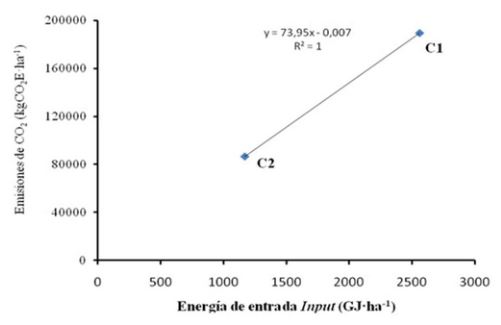
The research was developed in the Agricultural Production Cooperative (CPA) “VI Congreso Campesino”, belonging to Niquero municipality, Granma province, Cuba, dedicated to the cultivation of sugarcane (Saccharum officinarum L.), with the purpose of evaluating the energy consumption of this crop in two different campaigns. In the 2016-2017 campaign (C1), the highest Input energy consumption of 2 563.01 GJ ha-1, direct and indirect use energy of 1 910.62 and 652.39 GJ ha-1, respectively, Output energy of 317 376.76 GJ ha-1, the lowest energy ratio (Ratio) and net energy ratio (NER) were presented. Similarly, the highest amount of CO2 emitted to the atmosphere was 189 534.59 kg CO2 E ha-1, contributing to the deterioration of the environment.
Downloads
Article Details

This work is licensed under a Creative Commons Attribution-NonCommercial 4.0 International License.
Those authors who have publications with this journal accept the following terms of the License Attribution-NonCommercial-ShareAlike 4.0 International (CC BY-NC-SA 4.0):
You are free to:
- Share — copy and redistribute the material in any medium or format
- Adapt — remix, transform, and build upon the material
- The licensor cannot revoke these freedoms as long as you follow the license terms.
Under the following terms:
- Attribution — You must give appropriate credit , provide a link to the license, and indicate if changes were made . You may do so in any reasonable manner, but not in any way that suggests the licensor endorses you or your use.
- NonCommercial — You may not use the material for commercial purposes .
- ShareAlike — If you remix, transform, or build upon the material, you must distribute your contributions under the same license as the original.
- No additional restrictions — You may not apply legal terms or technological measures that legally restrict others from doing anything the license permits.
How to Cite
References
ÁLVAREZ, R. L., PANEQUE, R. P., ÁLVAREZ, O., et al. 2006. Costo energético de las operaciones de siembra más comunes en Cuba. IIMA, Cuba.
BOWERS, W. 1992. Agricultural field equipment. In: Fluck, R. C. (Ed.). Energy in World Agriculture. Energy in Farm Production. Elsevier, Amsterdam, The Netherlands, pp. 117-129.
CRESPO, R. M., PANEQUE, P. y MIRANDA, A. 2018. Determinación del costo energético y de explotación de la cosecha mecanizada del arroz. Revista Ciencias Técnicas Agropecuarias, 27 (2): 1-10.
CHAMSING, A., SALOKHE, V. and SINGH, G. 2006. Energy consumption for selected crops in different regions of Thailand. Agricultural Engineering International: the CIGR Ejournal,VIII: 1-18.
DE LAS CUEVAS, H. R., GÓMEZ, I., HERRERA, M. I., et al. 2017. Automated system for determination of energy and operating costs of self-propelled machines. Revista Ciencias Técnicas Agropecuarias, 26 (2): 80-88.
DE LAS CUEVAS, H. R., RODRÍGUEZ, T., PANEQUE, P., et al. 2009. Costos energéticos de un conjunto tractor-máquina de siembra directa. Revista Ciencias Técnicas Agropecuarias, 18 (4): 8-12.
FERREIRA, R. 2015. Balance energético de la caña de azúcar producida mediante tecnologías de producción orgánica y convencionalTesis para optar por el título de Ingeniero Agrícola. Facultad de Ciencias Agropecuarias, Universidad Central “Marta Abreu” de Las Villas, Cuba.
GEZER, I., ACAROGLU M. and HACISEFEROGULLARI, H. 2003. Use of energy and labour in apricot agriculture in Turkey. Biomass and Bioenergy, 24: 215-219.
GREEN, M. B. 1987. Energy in pesticide manufacture, distribution and use. In: Helsel, Z. R. (Ed.) Energy in World Agriculture. Elsevier, Amsterdam, The Netherlands, pp. 165-177.
HERMIDA, Y., FERNÁNDEZ, Y., LLANES, A., et al. 2016. Plantación de caña de a azúcar en surco de base ancha, una opción viable y sostenible para mitigar el cambio climático. ICIDCA sobre los Derivados de la Caña de Azúcar, 50 (1): 55-58.
HERNÁNDEZ, A., PÉREZ-JIMÉNEZ, J. M., BOSCH, D., et al. 2015. Clasificación genética de los suelos de Cuba. Ediciones INCA, Cuba, 91 p.
LAL, R. 2004. Carbon emission from farm operations. Environment International, 30(7): 981-990.
LÓPEZ, I., QUEIPO, O. y SALVADOR, F. 2018 Evaluación de los índices técnicos-explotativos y energéticos de las cosechadoras de caña de azúcar CASE IH A 8800. Universidad & Ciencia, 7 (3): 26-37.
LORA, D., RAMOS, R. y FERNÁNDEZ, M. 2015. Consumo energético de la maquinaria agrícola con el empleo de técnicas de agricultura de precisión. Revista Ingeniería Agrícola, 5 (2): 23-28.
MANDAL, K. G., SAHA, K. P., GHOSH, P. K., et al. 2002. Bioenergy and economic analysis of soybean-based crop production systems in central India. Biomass and Bioenergy, 23 (5): 337-345.
MINAG. 2008. Costos y vida útil de la maquinaria estimados. MINAG, Cuba.
OLIVET, Y. E. 2017. Balance energético de la preparación del suelo para el cultivo del frijol (Phaseolus vulgaris L.). REDEL. Revista Granmense de Desarrollo Local, 1 (3): 144-145.
OLIVET, Y. E. 2010. Efecto de tres sistemas de labranza en las propiedades físicas y en el consumo energético para el cultivo del tabaco (Nicotiana tabacum L.) en un Vertisol. Tesis para optar por el título de Doctor en Escuela Técnica Superior de Ingenieros Agrónomos. Universidad Politécnica de Madrid, Espana, 135 p.
OLIVET, Y. E., SÁNCHEZ-GIRÓN, V. y PARRA, L. R. 2014. Balance energético de tres tecnologías de labranza en un Vertisol para el cultivo del tabaco (Nicotiana tabacum L.). Revista Ingeniería Agrícola, 4 (2): 35-41.
PARRA, L. R., HERNANZ, J. L. y SÁNCHEZ-GIRÓN, V. 2017. Influencia de cuatro sistemas de laboreo en las propiedades físicas de un Fluvisol y en el balance energético en cultivos de raíces y tubérculos. Revista Universidad & Ciencia, 6 (1): 65-81.
PIMENTEL, D. 1992. Energy Imputs in Production Agriculture. In: Fluck, R. C. (Ed.). Energy in World Agriculture. Elsevier, Amsterdam, The Netherlands, pp. 13-29.
PINO, J. C., BELTRÁN, R. F., MENA, E. R., et al. 2016. Análisis comparativo de los indicadores técnicos explotativos en las cosechadoras de caña KTP-2M y KTP-3000S. Ingenius. Revista de Ciencias y Tecnología, 16: 12-19.
PONCE, F., ÁLVAREZ, E. GONZÁLES, Y., et al. 2008. Influencia de las tecnologías de labranza- siembra sobre los costos energéticos y de explotación de la técnica empleada y la contaminación del aire en el cultivo del frijol. Revista Ciencias Técnicas Agropecuarias, 17 (4): 13-18.
RECALDE, M. 2017. La inversión en energías renovables en Argentina. Revista de Economía Institucional, 19 (36): 231-254.
REID, A., GONZALEZ, V., SIKKEMA, P. H., et al. 2014. Delaying weed control lengthens the anthesis-silking interval in maize. Weed Science, 62 (2): 326-370.
RODRÍGUEZ, L. 2016. Balance energético para el cultivo del fríjol (Phaseolus vulgaris L.) en la Unidad Básica de Producción Cooperativa “14 de Junio”. Tesis para optar por el título de Ingeniero Agrícola. Facultad de Ciencias Técnicas, Universidad de Granma, Cuba, 38 p.
SAUNDERS, C., BARBER, A. y TAYLOR, G. 2006. Food Miles - Comparative Energy/Emissions Performance of New Zealand’s Agriculture Industry. The Agribusiness and Economics Research Unit (AERU), Lincoln University, Research Report No., 285, New Zealand, 119 p.
STATSOFT. 2003. Statistica for Windows, version 6. Tulsa, Oklahoma, USA.