

Tres métodos para determinar los requerimientos hídricos en el cultivo de zanahoria (Daucus carota L.) cv. ‘Chantenay’
Barra lateral del artículo
Contenido principal del artículo
Resumen
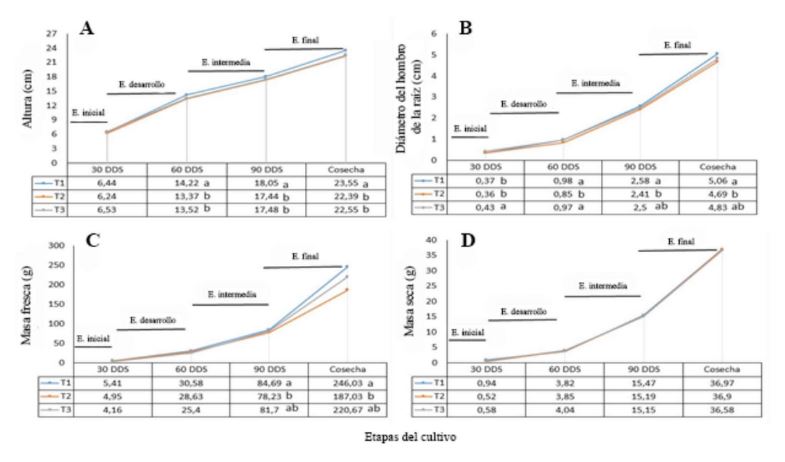
La investigación tuvo como objetivo evaluar tres métodos para determinar los requerimientos hídricos en el cultivo de zanahoria (Daucus carota L.) cv. ‘Chantenay’ en Macají, cantón Riobamba, provincia de Chimborazo, Ecuador. Se utilizó un diseño de bloques completamente aleatorizado y se adaptó a condiciones de riego por goteo. Se incluyeron tres tratamientos y tres repeticiones, según el abatimiento de humedad del suelo, ellos fueron: tanque de evaporación 25 % (T1), fórmulas empíricas de FAO-56 25 % (T2) y lisímetro al momento del drenaje (T3). Se determinó la duración de las etapas fenológicas en los tratamientos y se evaluaron en cada etapa las variables: altura de la planta, diámetro del hombro de la raíz, rendimiento, porcentaje de materia seca, correlación entre el agua utilizada y rendimiento. Se determinó el rendimiento en primera, segunda y tercera etapa y el rendimiento total, además del ajuste de Kc en los tratamientos en cada etapa fenológica. Se establecieron cuatro etapas fenológicas para el cultivo: etapa inicial, etapa de desarrollo, etapa intermedia y etapa final. Los resultados mostraron que las diferentes láminas influyeron en el rendimiento de la zanahoria. En la aplicación de agua el mejor tratamiento fue el T3 con un volumen de 404,76 mm, donde se obtuvo un rendimiento de 61,49 t ha-1. Se ajustó el Kc según el lisímetro para cada una de las etapas fenológicas: inicial de 0,83, desarrollo de 1,06, intermedia con 1,02 y la etapa final de 0,86, como resultado de la reposición del agua de riego al momento del drenaje.
Downloads
Detalles del artículo

Esta obra está bajo una licencia internacional Creative Commons Atribución-NoComercial 4.0.
Aquellos autores/as que tengan publicaciones con esta revista, aceptan los términos siguientes de la Licencia CC Atribución/Reconocimiento-NoComercial-CompartirIgual 4.0 Internacional (CC BY-NC-SA 4.0):
Usted es libre de:
- Compartir — copiar y redistribuir el material en cualquier medio o formato
- Adaptar — remezclar, transformar y construir a partir del material
- La licenciante no puede revocar estas libertades en tanto usted siga los términos de la licencia
Bajo los siguientes términos:
- Atribución — Usted debe dar crédito de manera adecuada , brindar un enlace a la licencia, e indicar si se han realizado cambios . Puede hacerlo en cualquier forma razonable, pero no de forma tal que sugiera que usted o su uso tienen el apoyo de la licenciante.
- NoComercial — Usted no puede hacer uso del material con propósitos comerciales .
- CompartirIgual — Si remezcla, transforma o crea a partir del material, debe distribuir su contribución bajo la la misma licencia del original.
- No hay restricciones adicionales — No puede aplicar términos legales ni medidas tecnológicas que restrinjan legalmente a otras a hacer cualquier uso permitido por la licencia.
Cómo citar
Referencias
ALEMAN, C. C. and MARQUES, P. A. 2016. Manejo e viabilidade econômica da irrigação no cultivo de Calendula officinalis L. Brazilian Journal of Irrigation and Drainage, Edição Especial: 29-37.
ALLEN, R. G., PEREIRA, L. S., RAES, D., et al. 1998. Crop Evapotranspiration-Guidelines for Computing Crop Water Requirements-FAO Irrigation and Drainage Paper 56. FAO, Rome, Italy, 300 p.
ALLEN, R.G., PEREIRA, L. S., RAES, D., et al. 2006. Evapotranspiración del cultivo: Guías para la determinación de los requerimientos de agua de los cultivos. Estudio FAO Riego y Drenaje No. 56. FAO, Rome, Italy, 298 p.
BARBIERI, J. D., LOURENÇO de FREITAS, P. S., DALLACORT, R., et al. 2020. Influence of soil coverage on evapotranspiration and dual crop coefficients on soybean. Journal of Experimental Agriculture International, 42 (6): 111-125.
CAICEDO, W. F. y SONO, F. X. 2014. Fertilización química en el cultivo de zanahoria (Daucus carota) Con 3 fuentes nitrogenadas más el micronutriente boro precursores de carotenos y la vitamina A. Tesis para optar al título de Bachiller. Universidad Técnica de Cotopaxi, Ecuador, 113 p.
CÁMARA DE COMERCIO DE BOGOTÁ. 2015. Manual zanahoria. Núcleo Ambiental S.A.S., Bogotá, Colombia, 24 p.
CARVALHO, D. F., NETO, O., FELIX, L. F., et al. 2016. Yield, water use efficiency, and yield response factor in carrot crop under different irrigation depths. Ciência Rural, 46 (7): 1145-1150.
DOMÍNGUEZ, A., de JUAN, J. A., TARJUELO, J. M., et al. 2012. Determination of optimal regulated deficit irrigation strategies for maize in a semi-arid environment. Agricultural Water Manage, 110: 67-77.
ENCISO, Z. 2011. Evaluación de zanahorias sembradas en verano. Investigación Agraria, 13 (2): 75-79.
FAO. 2006. La calidad en frutas y hortalizas. en: Manual para la preparación y venta de frutas y hortalizas: del campo al mercado. Disponible en: http://www.fao.org//docrep/006. Consultado 30/03/2021.
FAO. 2017. Water for Sustainable Food and Agriculture-A report produced for the G20 Presidency of Germany. FAO, Rome, Italy, 33 p.
FORERO-ULLOA, F. E., CELY-REYES, G. E. y NEIRA-RODRÍGUEZ, E. E. 2015. Requerimientos hídricos de la zanahoria (D. carota L.) durante tres etapas de su desarrollo. Ciencia y Agricultura, 12 (2): 43-50.
GARAY, O. 2009. Manual de uso consuntivo del agua para los principales cultivos de los Andes Centrales Peruanos. No. F06 G37-F. Instituto Geofísico del Perú, Lima, Perú.
GARCÍA, M., PUPPO, L., HAYASHI, R., et al. 2012. Metodología para determinar los parámetros de un suelo a campo. Grupo del Desarrollo del Riego, Montevideo, Uruguay. Disponible en: http://www.grupodesarrolloriego.uy/pdf/2-seminario-2012/Metodologia-para-determinar-los-parametros-hidricos-de-un-suelo-a-campo.pdf. Consultado 30/03/2021.
LEÓN, J. 2016. Modelación matemática para estimar los requerimientos hídricos del cultivo de papa (Solanum spp). Tesis para optar al título de Doctor en Recursos Hidráulicos. Escuela Superior Politécnica de Chimborazo, Riobamba, Ecuador, 188 p.
LÓPEZ, F. 2011. Estudio de factibilidad para la producción y comercialización de la zanahoria (Daucus carota L.), híbrido Cupar, en el Chaupi, provincia de Pichincha. Tesis para optar al título de Ingeniero en Agroempresas. Universidad San Francisco de Quito, Quito, Ecuador, 62 p.
MALLMA, C. T. y MEJÍA, M. J. 2015. Huella hídrica de productos agrícolas producidos en la Sierra central y comercializados en Lima. Apuntes de Ciencia & Sociedad, 05 (01): 128-134.
OCTURA, R. J., GADIAWARE, L. P. and OCTURA, R. E. 2020. Estimating evapotranspiration and crop coefficient of vegetable crops using pot micro-lysimeters. Philippine Journal of Science, 149 (4): 1107-1118.
PEREIRA, L. S., PAREDES, P., HUNSAKER, D. J., et al. 2021. Standard single and basal crop coefficients for field crops. Updates and advances to the FAO 56 crop water requirements method. Agricultural Water Management, 243 (106466): 1-33.
SAHARA, M., YADAV, A., DAHIYA, M., et al. 2006. Efecto de los niveles de riego en la producción de raíces de variedades de zanahoria recién desarrolladas. Haryana Journal of Horticultural Sciences, 35 (3): 364-365.
SENAGUA. 2017. Diagnóstico de las estadísticas del agua en el Ecuador. Secretaria Nacional del Agua. Disponible en: http://www.silo.tips/download/diagnostico-de-las-estadisticas-del-agua-en-ecuador-informe-final. Consultado 30/03/2021.
WANG, J., ZHANG, Y., GONG, S., et al. 2018. Evapotranspiration, crop coefficient and yield for drip-irrigated winter wheat with straw mulching in North China Plain. Field Crops Research, 217: 218-228.