
Mezcla de oligogalacturónidos para la fitoextracción de metales pesados en suelos contaminados
Barra lateral del artículo
Contenido principal del artículo
Resumen
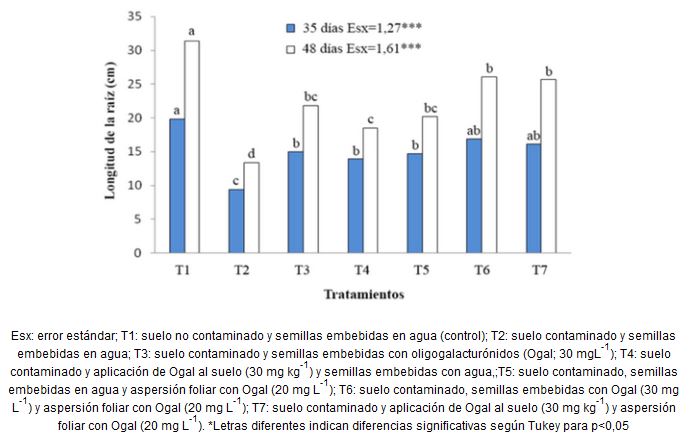
La mezcla de oligogalacturónidos (Ogal) permite la formación de enlaces con metales pesados y modificar la distribución de los cationes metálicos Cu, Cd y Fe en el suelo, así como atenuar los efectos tóxicos en plántulas de tomates, debido a su alta proporción de grupos funcionales ácidos ionizables. Los oligogalacturónidos están constituidos por una cadena lineal de moléculas de ácido galacturónico unidas por enlaces α-1-4. Se consideran que son bioestimulante de las plantas. En el presente trabajo se determinó el efecto de una mezcla de Ogal en plantas de tomate (Solanum lycopersicum L.), que confirmaron que se les puede usar para cultivar esta y probablemente otras especies en suelos con niveles elevados de esos cationes metálicos. La aplicación de la mezcla de Ogal en diferentes formas y sus combinaciones, modificó la biodisponibilidad de dichos cationes en un suelo contaminado, favoreciendo el proceso de fitoextracción por plantas de tomate. Adicionalmente, se estimuló la producción de biomasa sin que las plantas manifestasen síntomas visuales de fitotoxicidad. Los resultados de este trabajo ofrecen una alternativa para el uso de la mezcla Ogal en otros cultivos hiperacumuladores para fitorremediar suelos contaminados con cationes de metales pesados.
Downloads
Detalles del artículo

Esta obra está bajo una licencia internacional Creative Commons Atribución-NoComercial 4.0.
Aquellos autores/as que tengan publicaciones con esta revista, aceptan los términos siguientes de la Licencia CC Atribución/Reconocimiento-NoComercial-CompartirIgual 4.0 Internacional (CC BY-NC-SA 4.0):
Usted es libre de:
- Compartir — copiar y redistribuir el material en cualquier medio o formato
- Adaptar — remezclar, transformar y construir a partir del material
- La licenciante no puede revocar estas libertades en tanto usted siga los términos de la licencia
Bajo los siguientes términos:
- Atribución — Usted debe dar crédito de manera adecuada , brindar un enlace a la licencia, e indicar si se han realizado cambios . Puede hacerlo en cualquier forma razonable, pero no de forma tal que sugiera que usted o su uso tienen el apoyo de la licenciante.
- NoComercial — Usted no puede hacer uso del material con propósitos comerciales .
- CompartirIgual — Si remezcla, transforma o crea a partir del material, debe distribuir su contribución bajo la la misma licencia del original.
- No hay restricciones adicionales — No puede aplicar términos legales ni medidas tecnológicas que restrinjan legalmente a otras a hacer cualquier uso permitido por la licencia.
Cómo citar
Referencias
ALONSO-BRAVO, J. N., MONTAÑO-ARIAS, N. M., SANTOYO-PIZANO, G., et al. 2018. Biorecuperación y fitorremediación de suelo impactado por aceite residual automotriz. Journal of the Selva Andina Research Society, 9 (1): 45-51.
AMINIYAN, M. M., BAALOUSHA, M., MOUSAVI, R., et al. 2018. The ecological risk, source identification, and pollution assessment of heavy metals in road dust: a case study in Rafsanjan, SE Iran. Environmental Science and Pollution Research, 25 (14): 13382-13395.
BALDERAS, L. and SÁNCHEZ, Y. 2015. Biorremediation of soil polluted by 75000 ppm of waste motor oil applying biostimulation and phytoremediation with Sorghum vulgare and Bacillus cereus or Burkholderia cepacia. Journal Selva Andina Research Society, 6 (1): 23-32.
BEGUN, Z., RAHMAN, I., TATE, Y., et al. 2012. Remediation of toxic metal contaminated soil by washing with biodegradable aminopolycarboxylate chelants. Chemosphere, 87: 1161-1170.
CABRERA, J. C. 2000. Obtención de una mezcla de (1-4) a-D oligogalacturónidos bioactivos a partir de un grupo de subproductos de la industria citrícola. Tesis para optar al título de Doctor en Ciencias Agrícolas. Instituto Nacional de Ciencias Agrícolas, San José de las Lajas, Cuba, 100 p.
CARTAYA, O., MORENO, A., GURIDI, F., et al. 2017. Estudio de los complejos oligogalacturónidos-Cu(II) en solución y fase sólida. Revista Iberoamericana de Polímeros, 18 (1): 38-46.
CASTALDI, P., LAURO, G., SENETTE, C., et al. 2010. Role of the Ca-pectates on the accumulation of heavy metals in the root apoplasm. Plant Physiology and Biochemistry, 48 (12): 1008-1014.
HERNÁNDEZ-JIMÉNEZ, A., PÉREZ-JIMÉNEZ, J. M., BOSCHINFANTE, D., et al. 2015. Nueva Versión de Clasificación Genética de los Suelos de Cuba. Instituto de Suelos, La Habana, Cuba, 64 p.
IZQUIERDO, H., GONZÁLEZ, M. C. y NÚÑEZ, M. C. 2014. Estabilidad genética de las plantas de banano (Musa spp.) micropropagadas con reguladores del crecimiento no tradicionales. Biotecnología Aplicada, 31 (1): 18-22.
KABATA-PENDIAS, A. 2000. Trace elements in soils and plants. Tercera Edición. CRC Press, Boca Ratón, Estados Unidos de América, 403 p.
LARA-ACOSTA, D., COSTALES-MENENDEZ, D. y FALCÓN-RODRIGUEZ, A. 2018. Los oligogalacturónidos en el crecimiento y desarrollo de las plantas. Cultivos Tropicales, 39 (2): 127-134.
MEDEROS, Y., HORMAZA, J., REYNALDO, I., et al. 2020. Caracterización de mezclas de oligogalacturónidos Bioactivos. Revista CENIC Ciencias Químicas, 42 (2-3): 1-5.
NAVARRO, J. P., AQUILAR, I. A. y LÓPEZ-MOYA, J. R. 2007. Aspectos bioquímicos y genéticos de la tolerancia y acumulación de metales pesados en plantas. Ecosistemas, 16 (2): 1-17.
PANEQUE, M. 2002. Manual de técnicas analíticas para el análisis de suelos, foliar, abonos orgánicos y fertilizantes químicos. Instituto Nacional de Ciencias Agrícolas, La Habana, Cuba, 130 p.
PÉREZ, M. M. and BETANCUR, A. 2016. The impact of mining on the natural environment and current situation of Colombia. Sociedad y Ambiente, 10: 95-112.
PRIETO, J., GONZÁLEZ, C., ROMÁN, A. y PRIETO, F. 2009. Contaminación y fitotoxicidad en plantas por metales pesados provenientes de suelos y agua. Tropical and Subtropical Agroecosystems, 10 (1): 29-44.
RAURET, G., LÓPEZ-SÁNCHEZ, J. F., SAHUQUILLO, A., et al. 2000. Application of a modified BCR sequential extraction (three-step) procedure for the determination of extractable trace metal contents in sewage sludge amended soil reference material (CRM 483), complemented by a three-year stability study of acetic acid and EDTA extractable metal content. Journal of Environmental Monitoring, 2: 228-233.
REYES-PÉREZ, J. J., RAMOS-REMACHE, R. A., LLERENA-RAMOS, L. T., et al. 2021. Potencialidades de oligolacturónidos y quitosacáridos en el enraizamiento de las plantas. Terra Latinoamericana, 39: 1-9.
REYES-RODRÍGUEZ, R., GURIDI-IZQUIERDO, F., VALDÉS-CARMENATE, R., et al. 2019. Propiedades biológicas, ácidos húmicos y metales pesados biodisponibles en suelo Ferralítico bajo diferentes usos agrícolas. Revista Cultivos Tropicales, 40 (3): 2-7.
RODRÍGUEZ, P. H., GINCCHIO, R., BADILLA OHLBAUM, R., et al. 2002. Effect of soil copper content and pH on copper uptake of selected vegetables grown under controlled conditions. Environmental Toxicology and Chemestry, 21: 1736-1744.
RUBILI, H. 2016. Uso de Ácidos Fúlvicos y Girasol Ornamental en la Remediación de un Calcisol Contaminado con Plomo. Tesis para optar al título de Ingeniero Agrícola y Ambiental. Universidad Autónoma Agraria “Antonio Narro”, Buenavista, Saltillo, Coahuila, México, 76 p.
SILVA, P. 2012. Digestión en horno de microondas para determinación de contenido de hierro y zinc totales en alimentos. Tecnología en Marcha, 25 (3): 96-100.
YAGUAL-BARZOLA, K. R. 2020. Técnicas de recuperación de suelos contaminados por hidrocarburos aplicables en el cantón Salinas. La Libertad. UPSE, Matriz. Tesis para optar al título de Ingeniería en Petróleo. Facultad de Ciencias de la Ingeniería, Universidad Estatal Península Santa Elena, La libertad, Ecuador, 97 p.