

Evaluation of the effect of genotype-environment interaction on 19 sugarcane cultivars (Saccharum spp.) in Cienfuegos, Cuba
Article Sidebar
Main Article Content
Abstract
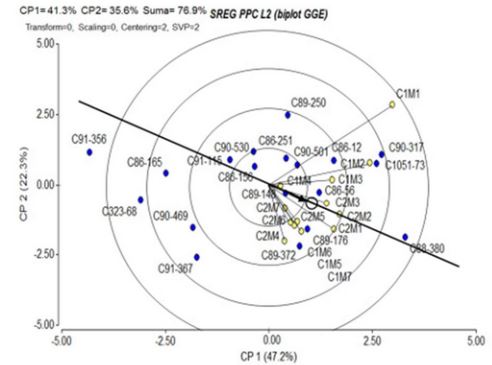
When cultivars present a differential response to diverse edaphoclimatic conditions, it is necessary to have high performance and stable genotypes, as well as stability allows the genotype to adjust its productive capacity to the widest environmental variation. The objective of this work was to determine the genotype-environment interaction in 19 sugarcane cultivars in the locality of Cienfuegos, in the variable Pol percentage. The study was carried out in the experimental block of sugarcane, located in Espartaco, Palmira, Cienfuegos, belonging to the Territorial Station of Sugarcane Research (ETICA Centro Villa Clara). The design used was a completely randomized block with three replications on a sialitic Brown soil, in the strains of cane plant and first ratoon. It was obtained as a result that the month of December in the ratoon strain (C2M2) is the ideal environment, where the cultivar ‘C88-380’ presented high yield and phenotypic stability, ‘C91-356’ presented the lowest yield values and ‘C91-367’ was the most unstable. Two mega-environments are formed, where cultivars ‘C90-317’, ‘C86-12’, ‘C90-501’ and ‘C1051-73’ are represented by environments C1M1 and C1M2, as well as ‘C88-380’, ‘C89-372’, ‘C89-176’, ‘C89-148’ and ‘C86-56’ with most of the remaining environments, while ‘C91-356’, ‘C323-68’, ‘C86-165’, ‘C91-115’, ‘C90-530’, ‘C86-156’, ‘C91-367’, ‘C90-469’, ‘C89-250’ and ‘C86-251’ are not related to any specific environment.
Downloads
Article Details

This work is licensed under a Creative Commons Attribution-NonCommercial 4.0 International License.
Those authors who have publications with this journal accept the following terms of the License Attribution-NonCommercial-ShareAlike 4.0 International (CC BY-NC-SA 4.0):
You are free to:
- Share — copy and redistribute the material in any medium or format
- Adapt — remix, transform, and build upon the material
- The licensor cannot revoke these freedoms as long as you follow the license terms.
Under the following terms:
- Attribution — You must give appropriate credit , provide a link to the license, and indicate if changes were made . You may do so in any reasonable manner, but not in any way that suggests the licensor endorses you or your use.
- NonCommercial — You may not use the material for commercial purposes .
- ShareAlike — If you remix, transform, or build upon the material, you must distribute your contributions under the same license as the original.
- No additional restrictions — You may not apply legal terms or technological measures that legally restrict others from doing anything the license permits.
How to Cite
References
BALZARINI, M. G. y DI RIENZO, J. A. 2016. InfoGen, versión 2016. FCA. Universidad Nacional de Córdoba, Argentina.
CAMARGO-BUITRAGO, I., QUIRÓS-MC INTIRE, E. y GORDÓN-MENDOZA, R. 2011. Identificación de ambientes representativos y discriminatorios para seleccionar genotipos de arroz mediante el biplot GGE. Agronomía Mesoamericana, 22 (2): 245-255.
CEPAL (Comisión Económica para América Latina y el Caribe). 2010. Efectos del cambio climático sobre la agricultura. Editorial México, D.F.: CEPAL, Costa Rica, 76 p.
CHERINET, A., WORKU, A., MEKONNEN, M., et al. 2016. GGE stability analysis of seed yield in sunflower genotypes (Helianthus annuus L.) in Western Amhara Region, Ethiopia. International Journal of Plant Breeding and Genetics, 10 (2): 104-109.
DELGADO-MORA, I. NUÑEZ-JARAMILLO, D., SUAREZ, H., et al. 2016. Evaluación de cultivares de caña de azúcar de madurez temprana, para el inicio de la zafra azucarera en suelos sialitizados no cálcicos. Centro Agrícola, 43 (2): 5-13.
DONOSO-ÑANCULAO, G., PAREDES, M., BECERRA, V., et al. 2016. GGE biplot analysis of multi-environment yield trials of rice produced in a temperate climate. Chilean Journal of Agricultural Research, 76 (2): 152-157.
GABRIEL, K. R. 1971. The Biplot-graphic display of matrices with applications to principal component analysis. Biometrika, 58: 453-467.
GAIKWAD, D. D., RATHOD, B. G. and GOSAVI, S. R. 2014. Genotype x environment interaction and adaptability for productive traits in sugarcane. International Journal of Current Research, 6 (2): 5220-5224.
HERNÁNDEZ, A., PÉREZ, J. M., BOSCH, D., et al. 1999. Nueva versión de clasificación genética de los suelos de Cuba. AGRINFOR, La Habana, 64 p.
HERNÁNDEZ, A., PÉREZ, J., ORTEGA, O., et al. 1975. II Clasificación genética de los suelos de Cuba. Revista Agricultura, VIII (1): 47-69.
JORGE, H., GARCÍA, H., JORGE, I., et al. 2010. Red experiemental para el desarrollo de las investigaciones de la caña de azúcar en Cuba. ¿Necesarias? Revista Cuba & Caña, 2: 33-48.
JORGE, H., GONZÁLEZ, R., CASAS, M., et al. 2011. Normas y procedimientos del programa de mejoramiento genético de la caña de azúcar en Cuba. PUBLINICA, La Habana, Cuba, 308 p.
NÚÑEZ-JARAMILLO, D. 2014. Caracterización de cultivares de caña de azúcar de madurez temprana, para el inicio de la zafra azucarera en suelos Sialitizados no cálcicos. Tesis para optar por el título de Ingeniero Agropecuario. Facultad de Ciencias Agropecuarias, Universidad Central “Marta Abreu” de Las Villas, Cuba, 33 p.
PÉREZ, J. L. y MILANÉS, N. 1979. Determinación del área y de la forma de las parcelas experimentales, y del número óptimo de réplicas, para los experimentos en caña de azúcar. Ciencias de la Agricultura, 4: 111-115.
REA, R. O., DE SOUSA-VIEIRA, A., DÍAZ, M., et al. 2014. Genotype-environment interaction in sugarcane by AMMI and site regression models in Venezuela. Revista de Facultad de. Agronomía (LUZ), 31: 362-376.
REA, R. and DE SOUSA, O. 2002. Genotipe x enviroment interaction in sugarcane yield trials in the central Western region of Venezuela. Interciencia, 27 (11): 620-624.
RODRÍGUEZ, R. 2012. Perfeccionamiento del programa de mejora genética de la caña de azúcar (Saccharum spp para la obtención de nuevos genotipos tolerantes al estrés por déficit hídrico. Tesis para optar por el título de Doctor en Ciencias Agrícolas. INICA, La Habana, Cuba, 100 p.
SHITAHUN, A., HUSSEIN M. and TADESSE, F. 2017. Stability of sugarcane (Saccharum officinarum L.) genotypes for sugar yield under three soil types. Journal of Agricultural Science and Research (JASR), 4 (1): 13-18.
YAN, W. and TINKER, N. A. 2006. Biplot analysis of multi-environment trial data: Principles and applications. Canadian Journal of Plant Science, 86: 623-645.
YAN, W., HUNT, L. A., SHENG, Q., et al. 2000. Cultivar evaluation and mega-environment investigation based on the GGE biplot. Crop Science, 40: 597-605.
YAN, W., KANG, M. S. 2003. GGE Biplot Analysis: A Graphical tool for breeders, geneticist, and agronomists. CRC Press. Boca Raton, F. L. 271 p.