
Effectiveness of Hexazinone LS 25 for preemergent control of weeds in sugarcane
Article Sidebar
Main Article Content
Abstract
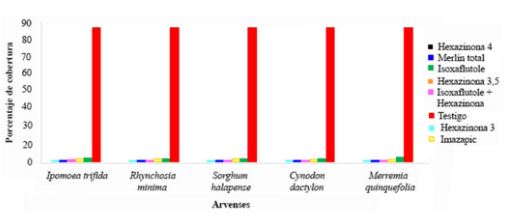
Given the country's financial deficit for the acquisition of pre-emergent herbicides, the Cuban chemical industry is developing new agrochemicals for the control of weeds in sugarcane. Of them, the effectiveness and toxic effect on the crop is unknown, among which is Hexazinone LS 25. An investigation was developed in commercial production areas of the production unit "Romana VII", Sugar Enterprise “America Libre” of Santiago de Cuba province with the objective of evaluating the effectiveness of Hexazinone LS 25 of national production and crop tolerance, compared with different pre-emergent herbicides for the control of weeds in sugarcane. An experiment was established in the period from September to December 2020 for the cold cycle and cultivar ‘B7274’, on a typical Brown soil with carbonates. A randomized block experimental design with eight treatments and five replications was used. The products evaluated were Isoxaflutole, Imazapic, Merlin Total, Hexazinone LS 25, as well as the combination Isoxaflutole + Hexazinone LS 25. The results were processed with the statistical package Statistica v. 8. It was demonstrated that the application of the national formulation of Hexazinone LS 25 at doses of 3.0 and 3.5 L ha-1 achieved the best control of weeds without causing phytotoxic damage to the crop.
Downloads
Article Details

This work is licensed under a Creative Commons Attribution-NonCommercial 4.0 International License.
Those authors who have publications with this journal accept the following terms of the License Attribution-NonCommercial-ShareAlike 4.0 International (CC BY-NC-SA 4.0):
You are free to:
- Share — copy and redistribute the material in any medium or format
- Adapt — remix, transform, and build upon the material
- The licensor cannot revoke these freedoms as long as you follow the license terms.
Under the following terms:
- Attribution — You must give appropriate credit , provide a link to the license, and indicate if changes were made . You may do so in any reasonable manner, but not in any way that suggests the licensor endorses you or your use.
- NonCommercial — You may not use the material for commercial purposes .
- ShareAlike — If you remix, transform, or build upon the material, you must distribute your contributions under the same license as the original.
- No additional restrictions — You may not apply legal terms or technological measures that legally restrict others from doing anything the license permits.
How to Cite
References
ALAM. 1974. Resumen del panel sobre métodos para la evaluación de ensayos en control de malezas en Latinoamérica. II Congreso de ALAM, Cali, Colombia, 12 p.
ARBOLEDA, J. 2019. Evaluación de mezclas de herbicidas post- emergentes y su relación de costos en el cultivo de caña de azúcar (Saccharum officinarum) variedad CC 934418. Tesis para optar al título de Ingeniero Agrónomo. Escuela de Ciencias Agrícolas, Pecuarias y del Medio Ambiente - ECAPMA, Universidad Abierta y a Distancia, Colombia, 54 p.
ARAÚJO, R., MARINHO, A., SOBRINHO, R., et al. 2020. Selectivity of herbicides applied, in pre-emergence, during the establishment phase of sugarcane. Scientific Electronic Archives, 13 (6): 16-24.
AVILA, J. 2018. Informe final de servicios en el cultivo de caña de azúcar Saccharum officinarum en la finca Agropecuaria Melimar S.A., Santo Domingo, Suchitepéquez. Tesis para optar al título de nivel medio de Técnico en Producción Agrícola. Universidad de San Carlos de Guatemala, Guatemala, 61 p.
CIBA-GEIGY. 1981. Manual para ensayos de campo en protección vegetal. Segunda edición. Basilea, Suiza: Editorial CIBA-Geigy, 205 p.
CHITOLINA, G., MENDES, K. and ALMEIDA, C. 2020. Influence of soil depth on sorption and desorption processes of hexazinona, Planta Daninha, 38: e0202177342020.
DÍAZ, J., GARCÍA, I. y MARTÍNEZ, R. 2003. MERLIN: Un herbicida efectivo en caña de azúcar. Cuba & Caña, 2 y 3: 5-10.
DOMÍNGUEZ, J. A. 2005. Metodologías para la evaluación de herbicidas en campo, Dpto, de Parasitología Agrícola, Universidad Autónoma Chapingo, Chapingo, Edo, de México, Disponible en: https://www.google.com/search?client=firefox-b-d&q=Metodolog%C3%ADas+para+la+evaluaci%C3%B3n+de+herbicidas+en+campo. Consultado 03/03/2020.
ESCOBEDO, C. 2017. Manejo integrado de arvenses. Disponible en: http://conservacion.cimmyt.org/es/component/docman/doc_view/2228 - enlace-no38. Consultado 13/03/2019.
ESQUIVEL, V. y MORENO, M. 2015. Control pre y postemergente de zacate peludo [Rottboellia cochinchinensis (Lour.) Clayton] en caña de azúcar con la mezcla formulada de Tebuthiurón/Diurón. Ciencia de la Maleza, 2 (2): 46-51.
ESTRADA, A. 2015. Alternativas químicas para el control de coyolillo (Cyperus rotundus) en caña de azúcar; finca el mirador, la gomera, escuintla sede regional de escuintla. Tesis para optar al título de Ingeniero Agrónomo. Facultad de Ciencias Ambientales y Agrícolas, Universidad Rafael Landívar, Escuintla, Guatemala, 49 p.
FERREIRA, D., SILVA, V. and SILVA, I. 2016. Control of three Euphorbia species through herbicides applied during preemergence on sugarcane Straw. Revista Brasileira de Herbicidas, 15 (4): 323-331.
HERNÁNDEZ, J. A. y ASCANIO, G. 1999. Nueva versión de clasificación genética de los suelos. Instituto de Suelos, Ministerio de la Agricultura, Cuba, 64 p.
HERNÁNDEZ, P. 2017. Efecto de diferentes métodos de control de arvenses en las propiedades del suelo, en plantaciones de teca, Tectona grandis L. Tesis para optar al grado de Ingeniero Forestal. Instituto Tecnológico de Costa Rica, Cartago, Costa Rica.
LERCH, G. 1977. La experimentación en las ciencias biológicas y agrícolas, Tomo I. Editorial Academia, 227 p.
NARANJO, S. 2020. Arvenses en un suelo cultivado con caña de azúcar con fertilización mineral y abono verde. Polibotánica, 50: 119-135.
ORDOÑEZ, G. 2016. Estudio de mercado para la comercialización de un herbicida de uso en el control de arvenses de hojas anchas en caña de azúcar. Disponible en: https://biblioteca-farmacia.usac.edu.gt/. Consultado 30/06/2015.
PINHEIRO, V. 2021. Metabolização de herbicidas inibidores do fotossistema ii em cultivares de cana-de-açúcar. Tesis para optar al título de Ingeniero Agrónomo. Faculdade de Ciências Agronômicas da Unesp Câmpus de Botucatu, Brasil, 95 p.
RODRIGUEZ, D. 2020, Efectividad de Mayoral® y Merlín Total® aplicados con el sistema Cosecho- Aplico®, combinado con la Fertilización en caña de azúcar. Centro Agrícola, 47 (3): 14-22.
SÁENZ, B. 2019. Efecto de tres dosis de herbicidas en caña de azúcar (Saccharum oficinarum L.) variedad Mex 73-1240. Tesis para optar al título de Ingeniero Agrónomo. Universidad San Pedro, Huacho, Perú, 42 p.
SÁNCHEZ, D. 2020. Eficacia y fitotoxicidad de varios herbicidas para el control de arvenses en dos variedades de caña de azúcar Saccharum sp. Tesis para optar al título de Ingeniero Agrónomo. Facultad de Ciencias Agrarias, Universidad de Guayaquil, Ecuador, 103 p.
SILVA, T. P., AZANIA, C. A. M., Xavier, M. A., et al. 2018. Sugarcane seedlings influenced by the management with herbicides. Planta Daninha, 36: e018150678.
STATSOFT, Inc. 2007. STATISTICA (Data Analysis Software System), version 8,0.
TAKANO, H., BIFFE, D. and CONSTANTIN, J. 2017. Dry season and soil texture affect the chemical control of monocotyledonous in sugarcane, Comunicata Scientiae, 8 (3): 477-485.
TOLEDO, R. E., FILHO, R. and NEGRISOLI, E. 2017. Management of morning glory (Ipomea hederifolia, Ipomea nil, and Merremia aegyptia) with herbicides in raw sugarcane during dry seasons. Revista Brasileira de Herbicidas, 16 (2): 84-90.
TOLEDO, A. y CRUZ, H. H. 2017. Control de arvenses en el cultivo de caña de azúcar con herbicidas preemergentes. Disponible en: https://docplayer.es/92245342-Control-de-malezas-en-el-cultivo-de-cana-de-azucar-con-herbicidas-preemergentes.html. Consultado 05/03/2019.