

Combined effect of bioactive products on common bean (Phaseolus vulgaris) cultivar ‘Buenaventura’ plants
Article Sidebar
Main Article Content
Abstract
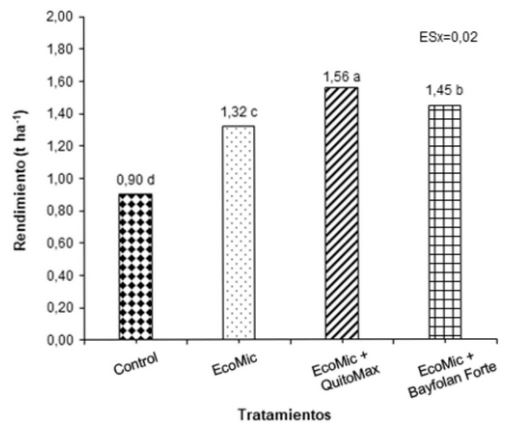
The production of common bean (Phaseolus vulgaris L.) still does not meet the needs of population consumption, given the limitations and low distribution of the technological package that includes several products of international origin that guarantee the management and health of the crop, among which the nutritional requirements are of great importance. The combined effect of different bioactive products on the growth and yield of common bean seeds cultivar ‘Buenaventura’, was evaluated. The experiment was conducted at the Jucaibama Experimental Station, belonging to the Instituto de Investigaciones Agropecuarias “Jorge Dimitrov”, Bayamo municipality, Granma province, during the months of December to March 2015-2016, on a poorly differentiated Fluvisol soil. Four treatments were evaluated (Mycorrhizae, and the combinations QuitoMax + Mycorrhizae and Bayfolan Forte + Mycorrhizae). A randomized block experimental design with three replications was used. The following indicators were evaluated: plant height (cm), stem diameter (cm), root length (cm), number of pods per plant, number of seeds per pod, seed mass (g), 100-seed mass (g) and yield (t ha-1). The data obtained were processed by a double ranked analysis of variance. Multiple comparison of means was performed through Duncan's test for p≤0.05. The statistical package Statistica, version 8.0 for Windows was used. The results showed that the combination of Mycorrhiza + QuitoMax increased growth, yield in common bean plants cultivar 'Buenaventura'.
Downloads
Article Details

This work is licensed under a Creative Commons Attribution-NonCommercial 4.0 International License.
Those authors who have publications with this journal accept the following terms of the License Attribution-NonCommercial-ShareAlike 4.0 International (CC BY-NC-SA 4.0):
You are free to:
- Share — copy and redistribute the material in any medium or format
- Adapt — remix, transform, and build upon the material
- The licensor cannot revoke these freedoms as long as you follow the license terms.
Under the following terms:
- Attribution — You must give appropriate credit , provide a link to the license, and indicate if changes were made . You may do so in any reasonable manner, but not in any way that suggests the licensor endorses you or your use.
- NonCommercial — You may not use the material for commercial purposes .
- ShareAlike — If you remix, transform, or build upon the material, you must distribute your contributions under the same license as the original.
- No additional restrictions — You may not apply legal terms or technological measures that legally restrict others from doing anything the license permits.
How to Cite
References
ÁLVARADO, K. 2018. Manejo agroecológico de la producción de posturas de cocotero (Cocos nucifera L.). Tesis para optar al título de Doctor en Ciencias Agrícolas, Universidad Agraria de la Habana “Fructuoso Rodríguez Pérez”, Mayabeque, Cuba, 100 p.
ÁLVAREZ, A., CAMPOS, A., BATISTA, E., et al. 2015. Evaluación del efecto del bionutriente Fitomas-E como alternativa ecológica en el cultivo del tomate. ICIDCA. Sobre los Derivados de la Caña de Azúcar, 49 (1): 3-9.
CALERO, A., CASTILLO, Y., QUINTERO, E., et al. 2018. Efecto de cuatro densidades de siembra en el rendimiento agrícola del frijol común (Phaseolus vulgaris L.). Revista de la Facultad de Ciencias, 7 (1): 88-100.
FALCÓN, A., COSTALES, D., CABRERA, J., et al. 2011. Chitosan physico-chemical properties modulate defense responses and resistance in tobacco plants against the oomycete Phytophthora nicotianae. Pesticide Biochemistry and Physiology, 100 (3): 221-228.
GARCÍA, A. V. 2011. Resultados experimentales en el cultivo del frijol con bioestimuladores del crecimiento vegetal. Disponible en: http://www.monografias.com/trabajos93/resultados-experimentales-cultivo-del-frijol bioestimuladores-del-crecimiento-vegetal/resultados-experimentales-cultivo-del-frijol-bioestimuladores-del-crecimiento-vegetal.shtml. Consultado 11/05/2015.
GONZÁLEZ, O., ABREU, B., HERRERA, M., et al. 2017. Uso del agua durante el riego del frijol en suelos Eutric Cambisol. Ciencias Técnicas Agropecuarias, 26 (1): 70-77.
GONZÁLEZ, R., NÚÑEZ, D. y BARCELÓ, R. 2012. Efecto de la aplicación de Rhizobium y Mycorriza en el crecimiento del frijol (Phaseolus vulgaris L) variedad CC-25-9 negro. Centro Agrícola, 39 (4): 17-20.
GONZÁLEZ, G. y PUPO, C. 2017a. Aplicación de micorrizas: Alternativa ecológica para la disminución o sustitución de fertilizantes químicos en el cultivo del maní. Revista DELOS: Desarrollo Local Sostenible, 10 (29): 1-15
MINAG. 2016. Producción sostenible de frijol en Cuba. Disponible en: https://www.minag.gob.cu/sites/default/files/noticias/produccion sostenible del frijol común en cuba.pdf. Consultado 24/04/2019.
MORALES, D., DELL’AMICO, J., JEREZ, E., et al. 2016. Efecto del QuitoMax® en el crecimiento y rendimiento del frijol (Phaseolus vulgaris L.). Cultivos Tropicales, 37 (1): 142-147.
MORALES, D., DELL’AMICO, J., RODRÍGUEZ, H. P., et al. 2014. Efecto del Quitomax en el crecimiento, las relaciones hídricas y el rendimiento y sus componentes en plantas de frijol (Phaseolus vulgaris L.) sometidas a dos manejos del agua de riego. XIX Congreso Científico Internacional del Instituto Nacional de Ciencias Agrícolas, 26-28 de noviembre, San José de las Lajas, Mayabeque, Cuba.
MUJICA-PÉREZ, Y., MEDINA-CARMONA, A., y RODRÍGUEZ-GUERRA, E. 2017. Inoculación de hongos micorrícicos arbusculares y bacterias promotoras del crecimiento vegetal en el cultivo de maní (Arachis hypogaea, L.). Cultivos Tropicales, 38 (2): 15-21.
NÁPOLES, M. C., CABRERA, J. C., ONDERWATER, R., et al. 2016. Señales producidas por Rhizobium leguminosarum en la interacción con frijol común (Phaseolus vulgaris L.). Cultivos Tropicales, 37 (2): 37-44.
NRAG. 2010. Semillas de frijoles y habichuelas (Phaseolus vulgaris, L.). Certificación. En: MINAG. (Ed.). Catálogo de Normas Ramales. MINAG, Cuba, pp. 289-289.
ONEI. 2018. Anuario Estadístico de Cuba. Capítulo 9: Agricultura, ganadería, silvicultura y pesca 2017, República de Cuba. Disponible en: http://www.onei.cu. Consultado 16/04/2019.
RIVERA, R., CALDERÓN, A., NÁPOLES, M. C., et al. 2015. La factibilidad de la aplicación conjunta de biofertilizantes y bioestimulantes en el cultivo del frijol. Instituto Nacional de Ciencias Agrícolas, Cuba.
RIVERA, R., NÁPOLES, M. C., FALCÓN, A., et al. 2015a. Factibilidad e impacto económico de la aplicación conjunta del EcoMic®, Azofert® y Quitomax® en la producción de frijol y su generalización en la provincia de Mayabeque. Instituto Nacional de Ciencias Agrícolas, Cuba, 16 p.
RODRÍGUEZ DIAZ, M. 2017. Respuesta agroproductiva de cuatro cultivares comerciales de Phaseolus vulgaris L. en época tardía. Tesis para optar al título de Ingeniero Agrónomo. Universidad Central “Martha Abreu” de Las Villas, Santa Clara, Cuba, 37 p.
TERRY, E., RUIZ, J., TEJEDA, T., et al. 2014. Interacción de bioproductos como alternativas para la producción horticultura cubana. Medio Ambiente y Desarrollo Sustentable, (3): 163-174.
VAN, T. N. and HANH, T. T. 2015. Application of chitosan solutions for rice production in Vietnam. African Journal of Biotechnology, 12 (4): 382-384.