

Strains and doses of rhizobia influence germination and growth of coffee plants in the pre-germinator
Article Sidebar
Main Article Content
Abstract
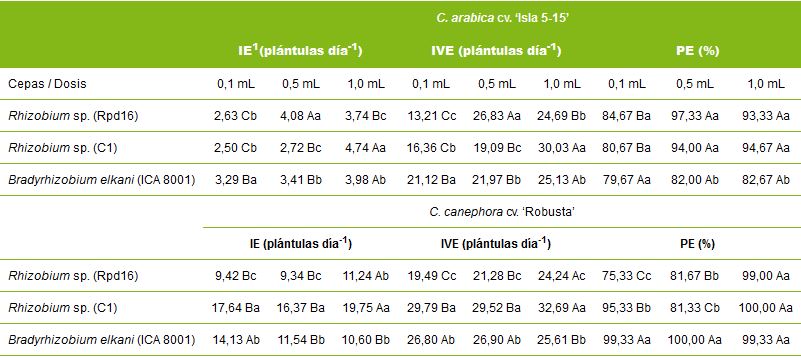
The use of plant growth promoting rhizobia is an interesting alternative to stimulate the development of coffee plants in the pre-germination phase, in the context of sustainable agriculture. The objective of this work was to evaluate the inoculation of strains and doses of rhizobia in coffee plants in pre-germination beds. The cultivars ‘Isla 5-15’ (Coffea arabica L.) and ‘Robusta’ (Coffea canephora Pierre ex Froehner) were used. A complete randomized design with a 3×3 factorial arrangement was used with an additional treatment (control without rhizobia), using three strains (Rhizobium sp. Rpd16, Rhizobium sp. C1 and Bradyrhizobium elkani ICA 8001) and three application rates (0.1, 0.5 and 1.0 mL per seed) as factors. The experiment was conducted in two phases: during germination and seed development. The percentage of emergence (PE), emergence index (EI) and emergence velocity index (EVI) of the seed were evaluated in the first phase. In the second phase, seedling height (PA) and root length (RL) were evaluated. The combination of strains and rhizobia doses influenced the two cultivars in the germination phase and showed little effect in the growth phase under pre-germination conditions. The strains that showed the best response in the two cultivars were Rhizobium sp. (Rpd16) and B. elkani (ICA 8001). The doses had effects only in the germination phase and were dependent on the strains evaluated in the different indices. These results suggest the use of rhizobial strains for the integrated management of coffee plants in their initial stage.
Downloads
Article Details

This work is licensed under a Creative Commons Attribution-NonCommercial 4.0 International License.
Those authors who have publications with this journal accept the following terms of the License Attribution-NonCommercial-ShareAlike 4.0 International (CC BY-NC-SA 4.0):
You are free to:
- Share — copy and redistribute the material in any medium or format
- Adapt — remix, transform, and build upon the material
- The licensor cannot revoke these freedoms as long as you follow the license terms.
Under the following terms:
- Attribution — You must give appropriate credit , provide a link to the license, and indicate if changes were made . You may do so in any reasonable manner, but not in any way that suggests the licensor endorses you or your use.
- NonCommercial — You may not use the material for commercial purposes .
- ShareAlike — If you remix, transform, or build upon the material, you must distribute your contributions under the same license as the original.
- No additional restrictions — You may not apply legal terms or technological measures that legally restrict others from doing anything the license permits.
How to Cite
References
AHEMAD, M. and KIBRET, M. 2014. Mechanisms and applications of plant growth promoting rhizobacteria: Current perspective. Journal of King Saud University Science, 26: 1-20.
BASET MIA, M. A., SHAMSUDDIN, Z. H. and MAHMOOD, M. 2012. Effects of rhizobia and plant growth promoting bacteria inoculation on germination and seedling vigor of lowland rice. African Journal of Biotechnology, 11: 3758-3765.
BÉCQUER, C. J., CANCIO, T., NÁPOLES, J. A., et al. 2018. Selección de rizobios por su efecto en la germinación y desarrollo incipiente de Moringa oleífera Lam. Fase I: condiciones controladas. Cuban Journal of Agricultural Science, 52 (4): 473-484.
BHERING, L. L. 2017. Rbio: a tool for biometric and statistical analysis using the R platform. Crop Breeding and Applied Biotechnology, 17: 187-190.
BLANCO, E. L., CASTRO, Y., OLIVO, A., et al., 2018. Germinación y crecimiento de plántulas de pimentón y lechuga inoculadas con rizobios e identificación molecular de las cepas. Bioagro, 30 (3): 207-218.
CASTANHEIRA, G. G., VEIGA, F. R., SERAFIM, C. L., et al. 2013. Minimum period to assess the potential of germination of coffee seeds. Journal of Seed Science, 35: 347-352.
CISNEROS, R. C. A., SÁNCHEZ, P. M. y MENJIVAR, F. J. C. 2017. Efecto de bacterias solubilizadoras de fosfatos sobre el desarrollo de plántulas de café. Agronomía Mesoamericana, 28 (1): 149-158.
COA, U. M., MÉNDEZ, N. J. R., SILVA, A. R., et al. 2014. Evaluación de métodos químicos y mecanismos para promover la germinación de fosforitos en café (Coffea arabica) var. Catuaí Rojo. IDESIA, 32: 43-53.
CUPERUS, F. 2016. An explorative case study on soil micronutrient availability in the province Groningen, The Netherlands. Tesis para optar al título de Master en Ecología de los Sistemas Agrarios. University of Wageningen, The Netherlands, 105 p.
DE FARIAS, E. T., AMARAL, S. E. A., TOOROP, P. E., et al. 2015. Expression studies in the embryo and in the micropylar endosperm of germination coffee (Coffea arabica cv. Rubi) seeds. Plant Growth Regulation, 75: 575-581.
DÍAZ, M. A., LÓPEZ, P. Y., SUÁREZ, P. C., et al. 2021. Efecto del Fitomas-E y dos proporciones de materia orgánica sobre el crecimiento de plántulas de cafeto en vivero. Centro Agrícola, 48 (1): 14-22.
ENCALADA, C. M. E., FERNÁNDEZ, P., JUMBO, N., et al. 2018. Evaluación del crecimiento de plántulas de Coffea arabica L. cv caturra en condiciones de vivero con diferentes sustratos y recipientes. Bosques Latitud Cero, 8 (1): 70-84.
GONZÁLEZ, V. M. E., ROSALES, J. P., CASTILLA, V. Y., et al. 2015. Efecto del Bioenraiz® como estimulante de la germinación y el desarrollo de plántulas de cafeto (Coffea arabica L.). Cuba. Cultivos Tropicales, 36 (1): 73-79.
GUEVARA, F. W., MACHADO-CARCASÉS, G. y BUSTAMANTE-GONZÁLEZ, C. A. 2021. Relación entre la fertilidad de sustratos y el crecimiento de posturas de café (Coffea arabica L.) en Contramaestre, Santiago de Cuba. Ciencia en su PC, 1: 94-110.
HASSAN, T. and BANO, A. 2015. The stimulatory effects of L-tryptophan and plant growth promoting rhizobacteria (PGPR) on soil health and physiology of wheat. Journal of Soil Science and Plant Nutrition, 15 (1): 190-201.
HERNÁNDEZ, F. I., NÁPOLES, G. M. C. y MORALES, M. B. 2015. Caracterización de aislados de rizobios provenientes de nódulos de soya (Glycine max (L.) Merril) con potencialidades en la promoción del crecimiento vegetal. Cultivos Tropicales, 36 (1): 65-72.
JIMÉNEZ, G. A., FLORES, F. J. D., GARCÍA, F. P., et al. 2018. Probiotic activities of Rhizobium laguerreae on growth and quality of spinach. Scientific Reports, 8: 295.
MAHMOOD, A., TURGAY, O. C., FAROOQ, M., et al., 2016. Seed biopriming with plant growth promoting rhizobacteria: a review. FEMS Microbiology Ecology, 92 (8): fiw112.
NÁPOLES, V. S., MILANES, R. S., GONZÁLEZ, C. L., et al. 2021. Rhizobia inoculation favor the growth of Coffea arabica L. seedlings grafted in a nursery. Research, Society and Development, 10 (6): e10110615722.
NOUMAVO, P. A., AGBODJATO, N. A., BABA-MOUSSA, F., et al. 2016. Plant growth promoting rhizobacteria: Beneficial effects for healthy and sustainable agriculture. African Journal of Biotechnology, 15 (27): 1452-1463.
ORGANIZACIÓN INTERNACIONAL DEL CAFÉ (OIC). 2021. Historical data on the global coffee trade. Disponible en: http://www.ico.org/new_historical.asp. Consultado 10/01/2021.
PARRAY, J. A., JAN, S., KAMILI, A. N., et al. 2016. Current perspectives on plant growth-promoting rhizobacteria. Journal of Plant Growth Regulation, 35 (3): 877-902.
PRIYA, M., KUMUTHA, K. and SENTHILKUMAR, M. 2019. Impact of bacterization of Rhizobium and Methylobacterium radiotolerans on germination and survivability in groundnut seed. International Journal of Current Microbiology and Applied Sciences, 8 (08): 394-405.
SUBIT, L. D., SIERRA, R. P. M. y CASANOVAS, C. E. 2020. El cultivo del café (Coffea arabica L.) y su susceptibilidad a la roya (Hemileia vastatrix Berkeley & Broome) en la provincia Cienfuegos. Revista Científica Agroecosistemas, 8 (3): 109-114.
VASALLO, R. L. 2019. La crisis de la producción del sistema agroforestal cafetalero en Cuba y su relación con la conservación de la biodiversidad. Tesis para optar al título de Doctor en Ecología. Universidad de Alicante, España, 214 p.
VINCENT, J. M. 1970. Manual for the practical study of root-nodule bacteria. Oxford and Edinburgh: Blackwell Scientific Publications, UK, 164 p.