

Population fluctuation of thrips associated with common bean (Phaseolus vulgaris L.) and their control by entomopathogenic fungi
Article Sidebar
Main Article Content
Abstract
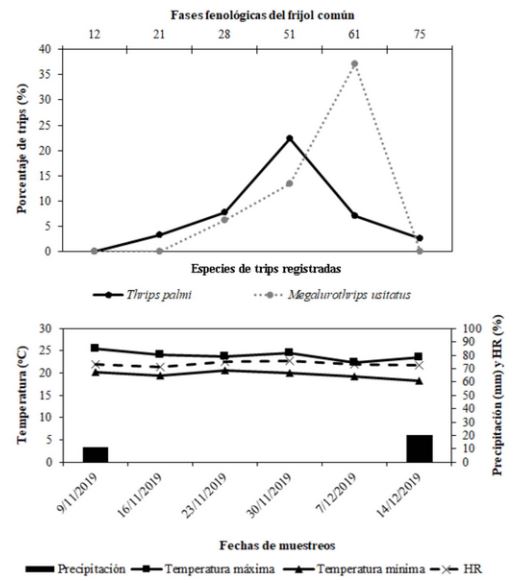
The thrips complex (Thysanoptera: Thripidae) is one of the most damaging insect pest groups affecting Phaseolus vulgaris in Cuba. With the objective of determining the population fluctuation of the thrips complex associated with P. vulgaris and its control by entomopathogenic fungi, a study was carried out at the San José farm, belonging to the municipality of Santa Clara, Cuba, during the months of October to April in the 2018-2019 and 2019-2020 planting seasons. During the first campaign, the presence of Thrips palmi was recorded in the phenological stage BBCH 21, which realized its population peak at the beginning of flowering with 46.61 % of the insects quantified. Although with lower incidence, the occurrence of Thrips tabaci was also recorded with two individuals during the entire crop cycle. In the second season, T. palmi made its population peak with the appearance of the first flower buds and the species Megalurothrips usitatus appeared in the BBCH 28 phase, which gradually reached its maximum population level at the beginning of flowering with 37.1 % of the insects quantified. The effectiveness of Beauveria bassiana Bb-18 on M. usitatus and T. palmi was demonstrated with 73 and 100 % mortality, respectively, while Metarhizium anisopliae Ma-30 caused 69 and 90 % mortality. Knowledge of the population fluctuation of thrips and the effectiveness of B. bassiana and M. anisopliae for their control are elements of interest for the establishment of an integrated management of thrips in Cuba.
Downloads
Article Details

This work is licensed under a Creative Commons Attribution-NonCommercial 4.0 International License.
Those authors who have publications with this journal accept the following terms of the License Attribution-NonCommercial-ShareAlike 4.0 International (CC BY-NC-SA 4.0):
You are free to:
- Share — copy and redistribute the material in any medium or format
- Adapt — remix, transform, and build upon the material
- The licensor cannot revoke these freedoms as long as you follow the license terms.
Under the following terms:
- Attribution — You must give appropriate credit , provide a link to the license, and indicate if changes were made . You may do so in any reasonable manner, but not in any way that suggests the licensor endorses you or your use.
- NonCommercial — You may not use the material for commercial purposes .
- ShareAlike — If you remix, transform, or build upon the material, you must distribute your contributions under the same license as the original.
- No additional restrictions — You may not apply legal terms or technological measures that legally restrict others from doing anything the license permits.
How to Cite
References
ACN. 2020. El mejor productor de granos de Cuba controla el thrip de la flor, Matanzas, Cuba. Disponible en: http://www.acn.cu/economia/61775-el-mejor-productor-de-granos-de-cuba-controla-el-thrip-de-la-flor-fotos/ Consultado: 27/07/2020.
AKRAM, M., NAIMUDDIN, K. and JAIN, R. K. 2012. Sequence diversity in the NSm gene of Groundnut bud necrosis virus isolates originating from different hosts and locations in India. Journal of Phytopathology, 160: 24-27.
CASTELLANOS, L., GARCÍA, J. A., YERO, Y., et al. 2011. Plagas y enfermedades en 13 variedades de frijol en una localidad de la provincia de Sancti Spíritus. Centro Agrícola, 38 (1): 91-92.
ETIENNE, J. and VAN WATERMUELEN, X. 1989. Thrips palmi (Karny) Thysanoptera: Thripidae et les autres revageurs de laubergine en Guadeloupe. In: INRA. (Ed.). Proceedings from Caribbean Food Crops Society Annual Meeting. Le Gossier, Guadalupe, Antilles-Guyana, pp. 398-410.
KAISER, D., BACHER, S., MÈNE-SAFFRANÉ, L., et al. 2018. Efficiency of natural substances to protect Beauveria bassiana conidia from UV radiation. Pest Management Science, 75: 556-563.
KEEIRO, A. U., NAZIR, T., ABDULLE, Y. A., et al. 2020. In vitro pathogenicity of the fungi Beauveria bassiana and Lecanicillium lecanii at different temperatures against the whitefly, Bemisia tabaci (Genn.) (Hemiptera: Aleyrodidae). Egyptian Journal of Biological Pest Control, 30: 41.
LACEY, L. A. 2012. Manual of Techniques in Invertebrate Pathology. Second edition, Academic Press, London, U. K., 484 p.
LEACH, A., FUCHS, M., HARDING, R., et al. 2019. Iris Yellow Spot Virus prolongs the adult lifespan of its primary vector, onion thrips (Thrips tabaci) (Thysanoptera: Thripidae). Journal of Insect Science, 19: 1-4.
LEWIS, T. 1973. Thrips: Their biology, ecology and economic importance. Academic Press, London, U. K., 349 p.
MATHARU, K. S. and TANWAR, P. S. 2020. Bioefficacy of novel insecticides against cotton thrips, Thrips tabaci (Thysanoptera: Thripidae). International Journal of Chemical Studies, 8: 1167-1170.
MEIER, U. 2001. Growth stages of mono-and dicotyledonous plants. Second edition, BBCH monograph, Federal Biological Research Centre for Agriculture and Forestry, Germany, 158 p.
ONEI. 2018. Capítulo 9. Agricultura, Ganadería, Silvicultura y Pesca. Anuario Estadístico de Cuba. Oficina Nacional de Estadísticas e Información, La Habana, Cuba, 33 p.
RILEY, D. G., JOSEPH, S. V., SRINIVASAN, R., et al. 2011. Thrips vectors of tospovirus. Journal of Integrated Pest Management, 2: 1-10.
SEAL, D. R. and STANSLY, P. A. 2000. Seasonal abundance and within plant distribution of melon Thrips (Thysanoptera: Thripidae) on beans in Southern Florida. Proceedings of the Florida State Horticultural Society, 113: 201-205.
TANG, L. D., YAN, K. L., FU, B. L., et al. 2015. The life table parameters of Megalurohrips usitatus (Thysanoptera: Thripidae) on four leguminous crops. Florida Entomology, 98: 620-625.
TSUTSUMI, C. Y., BULEGON, L. G. and PIANO, J. T. 2015. Melhoramento genetic do feijoeiro: avanços, perspectivas e novos estudos, no ámbito nacional. Nativa Sinop, 3: 217-223.
VAN MAANEN, R., BROUFAS, G., OVEJA, M. F., et al. 2012. Intraguild predation among plant pests: western flower thrips larvae feed on whitefly crawlers. BioControl, 57: 533-539.
VILLALOBOS, K., VARGAS, A. y GONZÁLEZ, A. 2011. Evaluación de Beauveria bassiana y Metarhizium anisopliae en condiciones de campo para el combate de trips en el cultivo de aguacate (Persea americana Mill.) en San Pablo de León Cortés, Costa Rica. Métodos en Ecología y Sistemática, 6 (3): 62-70.
WAN, Y., HUSSAIN, S., MERCHANT, A., et al. 2020. Tomato spotted wilt orthotospovirus influences the reproduction of its insect vector, western flower thrips, Frankliniella occidentalis, to facilitate transmission. Pest Management Science, 76: 2406-2414.
YANG, B., DU, C., ALI, S. and WU, J. 2020. Molecular characterization and virulence of fungal isolates against the bean flower thrips, Megalurothrips usitatus Bagnall (Thysanoptera: Thripidae). Egyptian Journal of Biological Pest Control, 30: 50.
ZAFIRAH, Z. and AZIDAH, A. A. 2018. Diversity and population of thrips species on legumes with special reference to Megalurothrips usitatus. Sains Malaysiana, 47: 433-439.
ZAFIRAH, Z., LOW, V. L. and AZIDAH, A. A. 2020. Non-monophyly and cryptic lineages between two morphoforms of Megalurothrips usitatus (Thysanoptera: Thripidae) in peninsular Malaysia: insights from morphological and molecular data. Journal of Asia-Pacific Entomology, 23: 554-558.