

Study of the vegetation of the Cagüey river mouth, Camagüey, Cuba
Article Sidebar
Main Article Content
Abstract
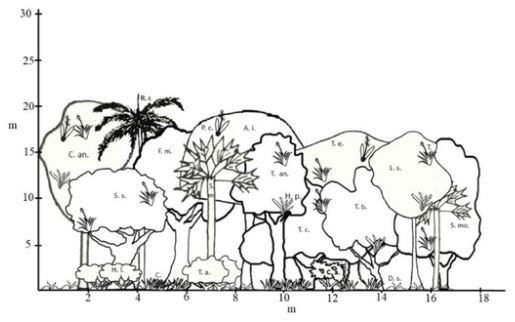
The vegetation around the mouth of the Cagüey River, located within the Río Máximo Fauna Refuge, north of Camagüey, was characterized. Six vegetal formations were identified and described, following the phytosociological method. The relevance of species richness in the general diversity of the ecosystems was demonstrated, with higher values in the evergreen microphyllous forest and the gallery forest. The synanthropic index showed the existence of intense human activity in the past and serious damage to the original vegetation cover. The following points were clarified in relation to the control of invasive species, the recovery of taxa threatened with extinction, and the rehabilitation of ecosystems, in the context of the management measures implemented by the protected area.
Downloads
Article Details

This work is licensed under a Creative Commons Attribution-NonCommercial 4.0 International License.
Those authors who have publications with this journal accept the following terms of the License Attribution-NonCommercial-ShareAlike 4.0 International (CC BY-NC-SA 4.0):
You are free to:
- Share — copy and redistribute the material in any medium or format
- Adapt — remix, transform, and build upon the material
- The licensor cannot revoke these freedoms as long as you follow the license terms.
Under the following terms:
- Attribution — You must give appropriate credit , provide a link to the license, and indicate if changes were made . You may do so in any reasonable manner, but not in any way that suggests the licensor endorses you or your use.
- NonCommercial — You may not use the material for commercial purposes .
- ShareAlike — If you remix, transform, or build upon the material, you must distribute your contributions under the same license as the original.
- No additional restrictions — You may not apply legal terms or technological measures that legally restrict others from doing anything the license permits.
How to Cite
References
ACADEMIA DE CIENCIAS DE CUBA e INSTITUTO CUBANO DE GEODESIA Y CARTOGRAFÍA. 1990. Estudio de los grupos insulares y zonas litorales del Archipiélago Cubano con fines turísticos; cayos Mégano Grande, Cruz, Romano y Guajaba. Editorial Científico Técnica, La Habana, Cuba.
BORHIDI, A. 1991. Phytogegraphy and vegetation ecology of Cuba. Akademiai Kiado, Budapest, Hungary, 858 p.
BRAUN, B. J. 1979. Fitosociología. Bases para el estudio de las comunidades vegetales. Blume Ediciones, Madrid, España, 820 p.
CAPOTE, R. y BERAZAÍN, R. 1984. Clasificación de las formaciones vegetales cubanas. Revista del Jardín Botánico Nacional, 5 (2): 27- 75.
GONZÁLEZ-TORRES, L., PALMAROLA, A., GONZÁLEZ-OLIVA, L., et al. 2016. Lista roja de la flora de Cuba. Bissea, 10 (NE 1): 1-352.
GREUTER, W. y RANKIN, R. 2017. Espermatófitos de Cuba, inventario preliminar. Botanischer Garten und Botanisches Museum, Berlin, Alemania, 665 p.
GREUTER, W. y RANKIN, R. 2019. Inventario de las plantas cubanas silvestres parientes de las cultivadas de importancia alimenticia, agronómica y forestal. Botanischer Garten und Botanisches Museum Berlin, Alemania, 75 p.
MARTÍNEZ-QUEZADA, E. 2017. Fitosociología y sintaxonomía de los manglares y saladaes de las lagunas costeras de los cayos Coco y Sabinal, Cuba. Acta Botánica Malacitana, 42 (2): 219-239.
OVIEDO, R. y GONZÁLEZ-OLIVA, L. 2015. Lista nacional de plantas invasoras y potencialmente invasoras en la República de Cuba - 2015. Bissea, 9 (NE 2): 1-68.
PÉREZ, E., AVILA, J., ENRÍQUEZ, N., et al. 1992. Flora y vegetación de la zona costera de los municipios Sierra de Cubitas y Minas, Camagüey, Cuba. Acta Botánica Cubana, 87: 1-24.
PÉREZ, E., VÁZQUEZ, R. y MARTÍN, R. 2014. Restauración ecológica según mecanismos funcionales de algunos ecosistemas boscosos y arbustivos costeros del norte de Camagüey, Cuba. Revista Forestal Baracoa, 33 (1): 33-42.
RICARDO, N., POUYÚ, E. and HERRERA, P. 1995. The synanthropic flora of Cuba. Fontqueria, 42: 367-430
RISCO, E., BARRETO, A., ENRÍQUEZ, N., et al. 1992. Algunos apuntes sobre la flora, vegetación y avifauna de los alrededores de la desembocadura del río Máximo, provincia de Camagüey. Reporte de Investigación, Instituto de Ecología y Sistemática, La Habana, Cuba.
RUIZ, I. 2017. Las áreas protegidas de Cuba. Editorial GAIA, Centro Nacional de Áreas Protegidas, La Habana, Cuba.
ZEQUEIRA, M., PLASENCIA, J., GONZÁLEZ, R., et al. 2020. Aproximación al beneficio económico ambiental perdido por el huracán “Irma” en la zona costera norte, provincia de Camagüey, Cuba. Revista Caribeña de Ciencias Sociales, 9 (2): 1-21.