
Optimal period for the evaluation of sugarcane orange rust disease in Cuba
Article Sidebar
Main Article Content
Abstract
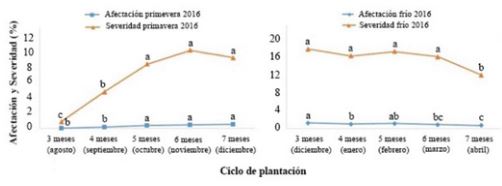
The results of 12 sugarcane cultivars evaluated against sugarcane orange rust disease on the plant strain in two planting cycles (spring and cold) are shown. The number of pustules and the length of the most frequent pustule on leaves +1, +3, +5 and +7 at three, four, five, six and seven months of age were evaluated in a 2 cm2 sampling station. The percentage of area occupied by pustules was calculated using a mathematical expression. Data were processed through the SPSS statistical package and analysis of variance and Tukey's test were performed for the sources of variation: leaves, evaluation dates, cultivars and cycles. The results showed differences for all sources of variation, leading to the conclusion that, although the affectations are not of great intensity, there are differences in the manifestation of symptoms in the different cultivars, and that studies to determine the presence of the disease and resistance of the genotypes should be carried out with cold plantings, also evaluating the +3 or +5 leaf when the crop is three and five months old.
Downloads
Article Details

This work is licensed under a Creative Commons Attribution-NonCommercial 4.0 International License.
Those authors who have publications with this journal accept the following terms of the License Attribution-NonCommercial-ShareAlike 4.0 International (CC BY-NC-SA 4.0):
You are free to:
- Share — copy and redistribute the material in any medium or format
- Adapt — remix, transform, and build upon the material
- The licensor cannot revoke these freedoms as long as you follow the license terms.
Under the following terms:
- Attribution — You must give appropriate credit , provide a link to the license, and indicate if changes were made . You may do so in any reasonable manner, but not in any way that suggests the licensor endorses you or your use.
- NonCommercial — You may not use the material for commercial purposes .
- ShareAlike — If you remix, transform, or build upon the material, you must distribute your contributions under the same license as the original.
- No additional restrictions — You may not apply legal terms or technological measures that legally restrict others from doing anything the license permits.
How to Cite
References
ADAY, O., ALFONSO, I., GONZÁLEZ, R., et al. 2014. Severidad de la roya naranja en cultivares de caña de azúcar infectados en la provincia de Villa Clara. Fitosanidad, 18 (3): 143-150.
ADAY, O., MONTALVÁN, J., DELGADO, J., et al. 2020. Orange rust disease progress in different plantation cycles of sugarcane in Cuba. Sugar Tech, 22 (6): 1057-1062.
ADAY, O., RODRÍGUEZ, E., MONTALVÁN, J., et al. 2018. Estado de dispersión e incidencia de la roya naranja de la caña de azúcar en Cuba. Centro Agrícola, 45 (2): 61-68.
ADAY, O., ALFONSO, I., RODRÍGUEZ, E., et al. 2017. Caracterización de los síntomas de la roya naranja (Puccinia kuehnii (W. Kruger) E. J. Butler) en cuatro cultivares de caña de azúcar en Cuba. Centro Agrícola, 44 (2): 61-67.
AGRIOS, G. N. 2005. Fitopatología. Editorial Limusa, S. A. de C. V., Distrito Federal de México, México, 947 p.
CHAULAGAIN, B., SMALL, I. M., SHINE, J. M., et al. 2020. Weather-based predictive modeling of orange rust of sugarcane in Florida. Phytopathology, 110 (3): 626-632.
DILLEWIJN, C. 1952. Botánica de la Caña de Azúcar. Edición Revolucionaria, La Habana, Cuba, 460 p.
DGSV-CNRF (DIRECCIÓN GENERAL DE SANIDAD VEGETAL-CENTRO NACIONAL DE REFERENCIA FITOSANITARIA). 2011. Roya anaranjada de la caña de azúcar (Puccinia kuehnii Kruger). SAGARPA-SENASICA, Distrito Federal de México, México, 5 p.
INICA (INSTITUTO DE INVESTIGACIONES DE LA CAÑA DE AZUCAR). 2011. Normas y Procedimientos del Programa de Mejoramiento Genético de la Caña de Azúcar en Cuba. PUBLINICA, La Habana, Cuba, 346 p.
JACKSON, P. 2018. Advances in Conventional Sugarcane Breeding Programmes. In: Rott, P. (Ed.). Achieving Sustainable Cultivation of Sugarcane. Burleigh Dodds Publishing Limited, Cambridge, United Kingdom, pp. 33-56.
LIMA, L. L. 2013. Aspectos epidemiológicos da ferrrugen alaranjada da cana-de acuçar (Puccinia kuenii). Tesis para optar al título de Doctor en Agronomía (Producción Vegetal). Facultad de Ciencias Agrarias y Veterinarias, Universidad Estadual Paulista-UNESP, Câmpus de Jaboticabal, Brazil, 65 p.
MAGAREY, R. C., ROYAL A., WILIAMS, D. J., et al. 2011. A brief history of disease epidemics in Queensland and of some economic outcomes. Proceedings of the Australian Society of Sugar Cane Technology, 33: 1-12.
MONTALVÁN, J. 2017. Adecuaciones al sistema evaluativo de la roya parda (Puccinia melanocephala Sydow and P. Sydow) en pruebas de resistencia de cultivares de caña de azúcar en Cuba. Tesis para optar por el título de Doctor en Ciencias Agrícolas. Universidad Central “Marta Abreu” de Las Villas, Cuba, 148 p.
OVALLE, W., OROZCO, H., FONG, E., et al. 2010. The effect of orange rust (Puccinia kuehnii) on sugar yield in six sugarcane varieties in Guatemala. International Society of Sugar Cane Technologists: Proceedings of the XXVII Congress, 7-11 March, Veracruz, Mexico.
RAID, R. N., COMSTOCK, J. C. and GLYNN N. 2011. Yield loss incited by orange rust (Puccinia kuehnii) on a highly susceptible sugarcane cultivar in Florida. Journal of the American Society of Sugar Cane Technologists, 31: 66-67.
RODRÍGUEZ, L. N. and SEIITI, A. 2018. Development of a single uredinium inoculation method for Puccinia kuehnii, the causal agent of sugarcane orange rust. Summa Phytopathologica, 44 (4): 311-316.
ROTT, P. C., KAYE, C., NARANJO, M., et al. 2016. Controlling sugarcane diseases in Florida: A challenge in constant evolution. Proceedings of the International Society of Sugarcane Technologists, 29: 595-600.
SINAVEF. 2013. Sistema Nacional de Vigilancia Epidemiológica Fitosanitaria. Disponible en: https://portal.sinavef.gob.mx. Consultado 25/06/2013.
TOWNSEND, G. R. and HEUBERGER, J. W. 1943. Methods for estimating losses caused by diseases in fungicides experiments. Plant Disease Reporter, 27: 340-343.
YANG. X., KANDEL, R., SONG, J., et al. 2018. Sugarcane genome, sequencing and genetic mapping. In: Rott, P. (Ed.). Achieving Sustainable Cultivation of Sugarcane. Burleigh Dodds Publishing Limited, Cambridge, United Kingdom, pp. 1-32.